The Lazy Girl Activewear Laundry System That Actually Prevents Smell
Quick Answer: The smell that survives washing is bacteria living in oils that ordinary detergent does not fully remove from synthetic fibers. Four low-effort fixes handle almost all of it: do not leave damp clothes balled up, use less detergent rather than more, skip fabric softener entirely, and wash inside out in cool water. If something already smells permanently, a one-time soak in a vinegar and water solution before washing usually resets it.
The frustrating version of this problem is not clothes that smell after a workout. It is clothes that smell after being washed.
That means the wash is not removing what it needs to remove, and the fix is a change to the process rather than more effort.
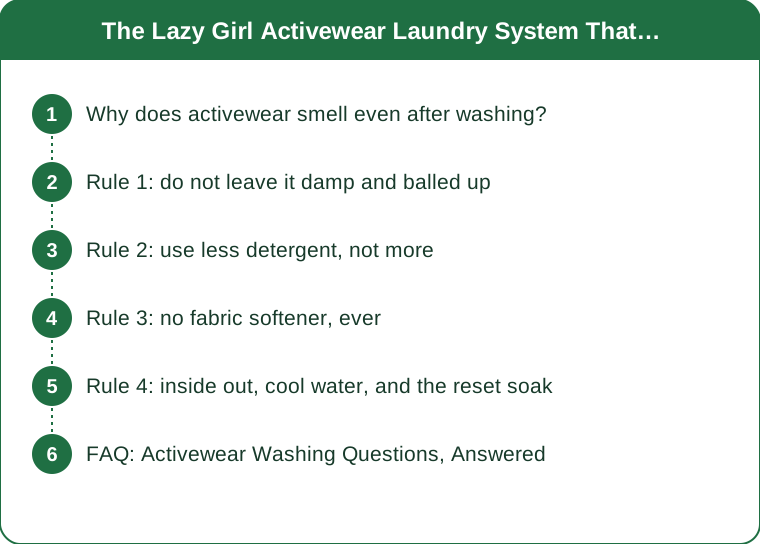
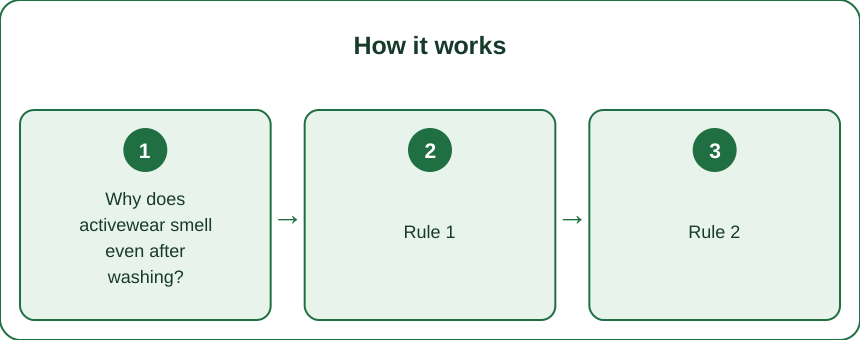
Why does activewear smell even after washing?
Because the smell source is oil-bound, and detergent is set up primarily to remove water-soluble soil.
Synthetic fibers, mostly polyester and nylon, are oleophilic, meaning they attract and hold oils. Your sebum and the compounds in sweat bind into the fiber structure rather than sitting on the surface.
Bacteria live in that oil residue. They are not killed by a cool wash and they are not fully removed by a normal detergent dose. When the garment gets warm and damp again, from your body heat, they resume producing the odor compounds and the smell reappears within minutes.
Which explains the two experiences everyone recognizes:
- Clothes that smell fine from the drawer and smell terrible five minutes into a workout
- Clothes that came out of the wash smelling clean and are back to smelling bad after one wear
Cotton does not do this to the same extent, because cotton is hydrophilic and releases oils more readily in a normal wash. This is why the problem feels specific to activewear. It is.
Rule 1: do not leave it damp and balled up
This is the single highest-impact habit and it costs nothing.
A damp garment in a gym bag or a laundry basket is a warm, moist, nutrient-rich environment. Bacterial populations grow rapidly, and the longer the delay, the more oil residue gets metabolized and the deeper the odor sets.
What to do instead:
- Take it out of the bag as soon as you get home, every time
- Hang it over the basket edge, a door, or a rail, so air reaches it
- Wash within a day or two rather than at the end of the week
If you cannot wash quickly, drying it out is nearly as good as washing it for preventing set-in odor. A dry garment does not develop worse smell; a damp one does.
The bag-specific version: a wet garment left in a zipped bag overnight is worse than the same garment left on the floor. The bag traps humidity. If you cannot deal with it right away, at least unzip the bag.
Rule 2: use less detergent, not more
This is the counterintuitive one, and it is where people who care most about the problem tend to go wrong.
Excess detergent does not rinse out fully. The residue builds up in the fiber and in the seams, and it holds onto oils and bacteria, which is precisely what you were trying to remove. Heavily built-up garments end up smelling worse the harder you try.
What to do:
- Use about half the recommended dose for a load of activewear. The recommendations assume heavy cotton soil.
- Skip the extra scoop for the smelly items, even though the instinct is strong
- Run an occasional extra rinse cycle if your machine has one, since rinsing matters more than dosing here
On specialized sport detergents: some do work better on oil-bound residue, and they are not required. Using less of a normal detergent and rinsing properly gets most of the benefit for free.
A useful diagnostic: if your activewear feels slightly slick or stiff when dry, that is residue, and you are using too much detergent.
Rule 3: no fabric softener, ever
Fabric softener works by depositing a thin waxy coating on fibers. On cotton towels that feels nice. On activewear it is actively harmful in two ways.
It traps odor-causing residue under the coating, where detergent cannot reach it, so the smell becomes progressively harder to remove.
It destroys moisture wicking. The coating is hydrophobic, which is the opposite of what technical fabric is engineered to do. A softener-treated top stops moving sweat and starts holding it, which makes you feel clammier during training and adds to the odor cycle.
Also on the avoid list:
- Dryer sheets, which do the same thing by a different route
- Very hot water, which can damage elastane and set some protein-based stains
- The hot dryer, which degrades elastane over time and shortens the life of everything with stretch. Air drying is genuinely better for activewear, and it is also less work.
What to use instead if you want softness: nothing. Technical knits do not need it, and the hand-feel they lose to softener is worse than any softness gained.
Rule 4: inside out, cool water, and the reset soak
Turn garments inside out before washing. The soiled surface is the inside, so this puts the residue in direct contact with water and detergent. It also protects the outer face from abrasion, which is what causes pilling.
Cool water, 30C or cold. Hot water is harder on elastane and does not improve oil removal enough to justify it. Cool plus a proper rinse beats hot plus residue.
Zip the zippers and close the hooks, so hardware does not snag the knits.
Mesh bag for anything with straps if you can be bothered, and skipping this is not a disaster.
The reset soak, for garments that already smell permanently:
- Fill a basin with cool water and add about one cup of white vinegar
- Submerge the garment fully and leave it for 30 to 60 minutes
- Wash normally afterwards, with no detergent added to the soak
The acidity helps break down the alkaline residue and bacterial byproducts that have accumulated. This is a periodic reset, not a routine step, and once or twice a year per garment is plenty. Do not combine vinegar with bleach or with detergent in the same soak.
Seasonal note: late summer is peak season for this problem, because sweat volume is at its annual high and clothes spend longer damp in a humid house. Getting the habits in place now means the winter version, where things dry slowly indoors, is much easier.
And the lazy summary: hang it up when you get home, half the detergent, no softener, inside out. Four things, none of which take extra time.
FAQ: Activewear Washing Questions, Answered
Why do my leggings smell as soon as I start sweating?
Bacteria live in oil residue bound into the synthetic fibers, and a normal wash does not fully remove it. Your body heat and moisture reactivate them, so the smell returns within minutes of starting to sweat.
Does more detergent help with activewear smell?
No, it makes it worse. Excess detergent leaves residue that traps oils and bacteria. Use roughly half the recommended dose and add an extra rinse instead.
Can I use fabric softener on activewear?
No. It coats the fibers, trapping odor residue underneath and destroying moisture wicking. Skip dryer sheets too, and air dry rather than using a hot dryer.
TL;DR:
- The smell is bacteria in oil residue bound to synthetic fibers, which ordinary washing does not fully remove.
- Hang damp clothes up as soon as you get home. Drying prevents set-in odor almost as well as washing does.
- Use half the detergent, add a rinse, and never use fabric softener or dryer sheets.
- Wash inside out in cool water, air dry, and use a one-hour vinegar soak once or twice a year to reset anything permanently smelly.
None of this is extra work. Three of the four rules are things you stop doing.
See It in Motion
Seen here: High Waist Yoga Leggings with Side Pockets — shop it on bubblelime.com
Keep Reading
This article is for general informational and styling purposes only. Fit, sizing, and product availability may vary.