Why Your Habit Survives the Weekend but Dies on Monday
Quick Answer: Weekends have flexible time, so a habit can move and still happen. Monday has fixed obligations, so a habit that gets displaced has nowhere to go. The fix is a smaller Monday version scheduled at a fixed time before the day starts making demands, not more willpower.
You assume the weekend is where habits go to die. Late nights, disrupted routine, no structure.
Then you look at the tracker and every gap is a Monday, or the Tuesday after a missed Monday.
This is one of the most common patterns in habit formation, and it is almost entirely about the shape of the day rather than the strength of the intention.

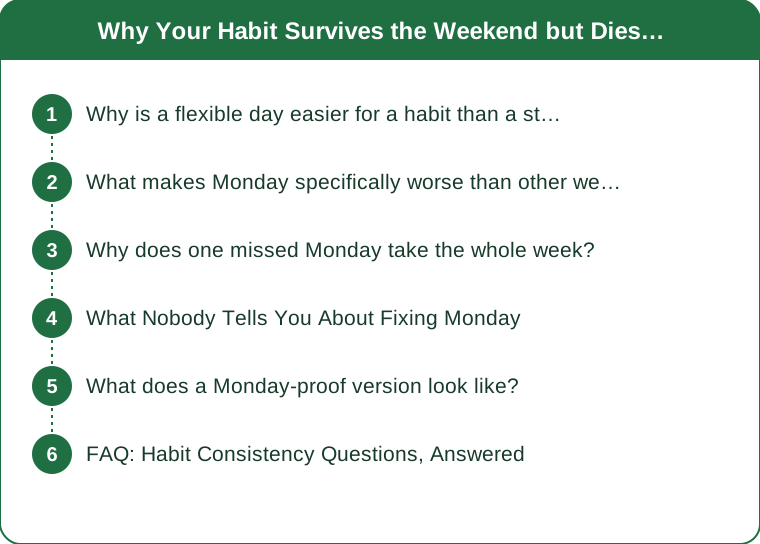
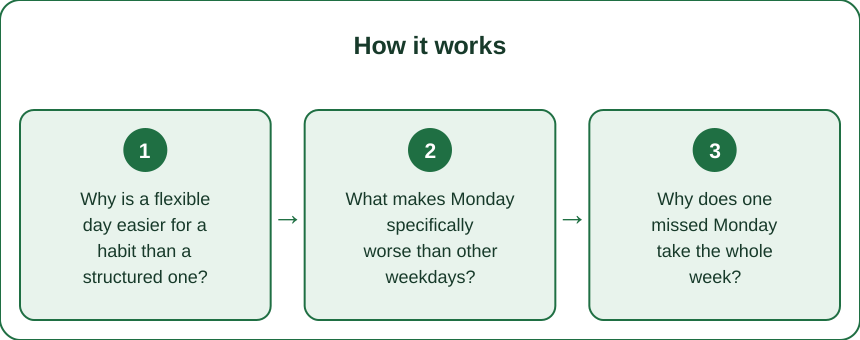
Why is a flexible day easier for a habit than a structured one?
Because flexibility means a habit can be displaced without being cancelled.
On a Saturday, if your walk does not happen at 9am, it can happen at 11, or at 3, or at 6. The habit has somewhere to go. Missing a slot is not the same as missing the day.
On a Monday, the day is a sequence of fixed commitments with narrow gaps between them. If the intended slot is consumed by something else, there is often no second slot at all. The habit does not get postponed — it gets deleted.
This is why weekends feel risky and turn out not to be. The risk factor people focus on is motivation, and the actual risk factor is slot availability. A day with three possible windows is dramatically more robust than a day with one, regardless of how you feel on either.
What makes Monday specifically worse than other weekdays?
Monday carries the accumulated load of the whole weekend, and it carries it first.
Everything deferred from Friday afternoon, everything that arrived over the weekend, and everything that has to be set up for the week all lands on the same morning. Monday has the highest density of obligations and the least slack of any day.
There is a second effect: you have not run the weekday routine for two days, so all the small automatic behaviours that carry a habit through a Wednesday are slightly cold. The bag is not where it usually is. The alarm was different. The cues have gone quiet.
And a third, more psychological: Monday carries an implicit fresh-start framing, which sounds helpful and is often the opposite. Fresh-start thinking encourages ambitious versions of things — the full session, the proper start — at exactly the moment the day has least room for it. An ambitious Monday plan fails, and the failure then sets the tone for Tuesday.
Why does one missed Monday take the whole week?
Because the first repetition of the week establishes whether the habit is active.
A missed Monday does not just cost one session. It moves the habit from running to not-currently-running, and restarting mid-week requires a fresh decision rather than a continuation. Continuation is nearly free and restarting is expensive, which is the entire reason streaks work as a mechanism.
There is also a self-image effect that arrives quickly. Two or three missed Mondays in a row and the internal description changes from someone who does this to someone who is trying to do this, which is a materially weaker position.
The practical implication is that Monday is worth protecting disproportionately. Not because Monday’s session matters more physically, but because Monday decides how many of the week’s other sessions happen. Protecting it is the highest-leverage scheduling decision in the whole week.

What Nobody Tells You About Fixing Monday
The Monday version should be smaller, not equal. A ten-minute version that happens beats a forty-minute version that does not, and the ten-minute version preserves the streak identically. Most people plan an identical session every day and lose the one day that could not support it.
Do it before the day starts making demands. Anything scheduled after the first obligation is negotiable; anything before it is not. This is why morning habits survive and evening habits erode, and it has nothing to do with morning people.
Prepare Monday on Sunday, not on Monday. Clothes out, bag packed, the thing in the doorway. Sunday evening has slack; Monday morning does not. Ten minutes on Sunday buys more than any amount of Monday determination.
Do not punish a missed Monday with a bigger Tuesday. Making up the session raises the cost of the restart, which is the last thing a wobbling habit needs. Just do Tuesday’s normal version.
Track Mondays separately. Once you can see that all the gaps are one day of the week, the problem stops being vague and becomes a scheduling task, which is a far easier thing to solve.
What does a Monday-proof version look like?
Small, fixed, prepared in advance, and defined as its own thing.
Define the minimum. Write down the smallest version that still counts. Ten minutes of movement. One set. A walk around the block. This is not a fallback for bad weeks — it is the Monday standard, permanently.
Fix the time and put it first. Not after work, not when there is a gap. Before the first obligation of the day, whatever hour that is.
Remove every decision. Same clothes, same activity, same place. Monday is not the day for choosing a workout, picking a route, or deciding what to do.
Prepare on Sunday. This is the single most effective step and the one people skip because Sunday feels far away from the problem.
Give it a completion rule that is easy to satisfy. Ten minutes on the clock and you are done, even if you feel like continuing. Consistency comes from a habit that is reliably finishable, and Monday is the day that most needs the finish line to be close.
Then let Tuesday to Friday be the ambitious days. They have room for it, and they will happen far more reliably once Monday has stopped taking the week down with it.
FAQ: Habit Consistency Questions, Answered
What if my hardest day is not Monday?
The principle transfers directly — find the day with fewest available slots and highest obligation density, and apply the small-fixed-prepared version to that one. For a lot of people it is Wednesday or the day of a standing commitment.
Should I take Monday off entirely instead?
That works if the schedule genuinely has no room, but it costs you the week-opening repetition that establishes the habit as active. A five-minute version usually beats a planned rest day for consistency purposes.
Does this change in September when schedules reset?
Considerably. Early autumn is when new obligations get added to weekdays, and habits that survived all summer start failing for purely structural reasons. Re-check your slot availability whenever the calendar changes rather than assuming the old plan still fits.
Is a streak actually helpful or just pressure?
Helpful up to the point where breaking it feels catastrophic. Counting weeks with at least four sessions rather than counting consecutive days keeps the continuation benefit without making a single missed day feel terminal.
TL;DR:
- Weekends are flexible, so a displaced habit still happens; Mondays are rigid, so a displaced habit disappears.
- Monday carries the highest obligation density and the coldest routine cues of the week.
- A missed Monday costs the week because restarting mid-week is far more expensive than continuing.
- Make Monday’s version deliberately smaller, put it before the first obligation, and prepare it on Sunday.
Look at your last month and mark which day each gap fell on. If a pattern shows up — and it usually does — you have a scheduling problem you can fix this weekend rather than a motivation problem you cannot.
Keep Reading
This article is for general informational and styling purposes only. Fit, sizing, and product availability may vary.