Why Your Low Effort System Breaks When the Season Changes
Quick Answer: Low-effort habits work because they are anchored to a cue, not to willpower, and seasonal change moves the cues. Sunrise shifts by more than an hour between June and September, evenings get dark sooner, and the clothes at the front of your drawer stop matching the weather. When the cue moves, the habit does not transfer, it simply stops firing. The fix is to re-anchor deliberately at the start of each season rather than assuming a working system is permanently working.
Your morning walk happened every day in July and has happened twice this month. Nothing went wrong. You did not decide to stop.
That is exactly what a broken cue looks like from the inside, and it is not a motivation problem.

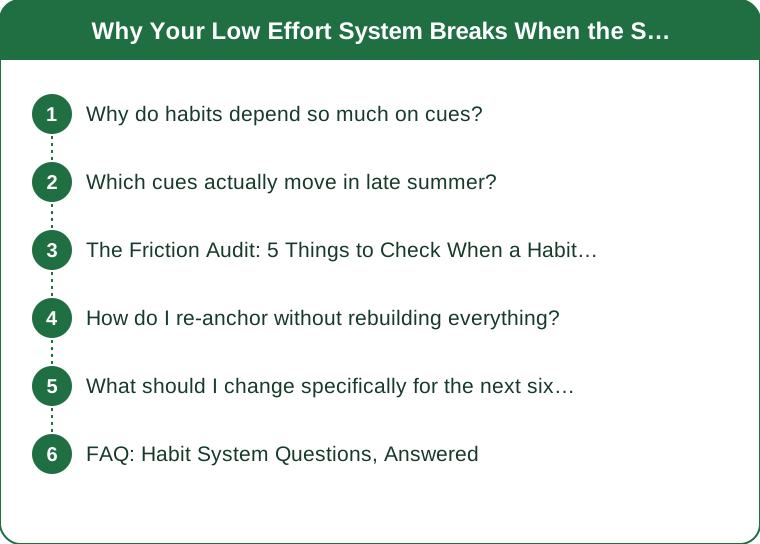
Why do habits depend so much on cues?
Because the whole point of a low-effort system is to remove the decision. A habit that requires you to decide is not a habit, it is a daily negotiation, and negotiations get lost on tired days.
A cue does the deciding. Light through the window means shoes on. Finishing dinner means ten minutes of stretching. The cue fires, the behaviour follows, and no willpower is spent.
This is why the smallest environmental change can have effects wildly out of proportion to its size. The habit was never held together by commitment. It was held together by a trigger, and triggers are physical things that live in your actual environment.
Late August moves several of them at once.
Which cues actually move in late summer?
More than people realise, and they move together:
Light timing. Sunrise in much of the US slips from around 5:30am in late June to past 6:20am by late August, and sunset pulls back by roughly an hour. Any habit anchored to natural light is now firing at a different clock time, or not at all.
Evening darkness. An after-dinner walk that happened in daylight in July now starts in dusk. The behaviour did not get harder, it got less appealing, which is functionally the same thing.
Clothing accessibility. What is at the front of your drawer stopped matching the weather. If putting the clothes on is the habit, and the clothes are now wrong, the habit has a new friction point.
Schedule. School restarts, work rhythms change, and the empty slot your habit lived in gets filled by something else without announcement.
The Friction Audit: 5 Things to Check When a Habit Dies
Instead of trying to want it more, look for the physical thing that changed.
-
Where does the object live? If your shoes moved from by the door to the closet, that is the whole story. Objects migrate quietly over a season.
-
What time does the cue actually fire now? If it was light-based, look up the current sunrise and sunset. You may be trying to run a 6am habit at what your body now reads as 5am.
-
What is in the way? A basket of laundry in front of the mat. A charger you have to unplug. Small physical obstacles kill habits at a rate wildly disproportionate to their size.
-
What replaced the slot? Something almost always did. Name it, and decide whether it wins or moves.
-
Is the reward still there? A walk that was pleasant at 75F and golden light is a different experience at 88F and humid, or at dusk. If the reward changed, the habit is now running on obligation, which does not last.
Most dead habits fail at number one or number three, and both are fixable in under five minutes.

How do I re-anchor without rebuilding everything?
You do not need a new system. You need to move the existing one four or five feet.
-
Re-anchor to a fixed cue rather than a natural one. Light moves seasonally. Finishing your coffee does not. Habits tied to another reliable habit survive season changes far better than habits tied to the sun.
-
Move the object to where the decision happens. Not where it belongs. Where you stand when you decide.
-
Shrink it temporarily. A habit that stalled restarts faster at half size. Ten minutes, not thirty. Get the cue firing again first, then rebuild the volume.
-
Change one thing, not the routine. People respond to a broken habit by redesigning the whole morning, which guarantees it never restarts. Fix the cue and leave everything else alone.
-
Schedule a seasonal check. Four times a year, spend ten minutes asking which of your routines depend on daylight. It is the cheapest maintenance you will ever do.
What should I change specifically for the next six weeks?
Late August into early October is the biggest cue shift of the year in most of the US, bigger than the spring one because it happens alongside schedule changes.
Move light-dependent habits earlier or indoors. An evening walk that will be dark by mid-September should become a lunch walk now, before it fails, rather than after.
Rotate the drawer before you need to. Put the transitional pieces at the front while the weather is still warm. The morning you need them is the morning you will skip rather than dig.
Expect two weeks of wobble. Habits that survive a season change usually dip for around ten to fourteen days and then re-stabilise. That dip is normal and is not evidence the system failed.
Keep one thing exactly the same. Whatever your most reliable daily anchor is, do not touch it during a transition. It is what everything else re-attaches to.
FAQ: Habit System Questions, Answered
Is it my fault the habit stopped?
No, and this matters practically rather than emotionally. If you diagnose it as a willpower failure, you will try to fix it with willpower, which is the one resource that was never holding it up.
How long does it take to re-establish a stalled habit?
Much less time than building it the first time, usually a few days to two weeks, because the behaviour itself is still learned. You are restoring a trigger, not building a skill.
Should I just use a phone reminder instead?
Reminders work poorly as primary cues because they are easy to dismiss and they arrive out of context. They work well as a temporary bridge for two weeks while a physical cue re-establishes.
What if the habit was seasonal to begin with?
Then let it end and replace it, rather than dragging it into a season it does not suit. A summer swim habit becoming an autumn strength habit is a system working, not failing.
TL;DR:
- Low-effort habits run on cues, not commitment, and late summer moves several cues at once.
- Sunrise, dusk, drawer contents and schedule all shift together in late August into September.
- Run a friction audit: where the object lives, what time the cue fires, what is in the way.
- Re-anchor to a fixed habit rather than daylight, shrink temporarily, and change only one thing.
A habit that stops in September is not a habit you failed at. It is a habit whose trigger moved. Move it back and you get the whole routine returned to you for about five minutes of work.
Keep Reading
This article is for general informational and styling purposes only. Fit, sizing, and product availability may vary.