The 15-Minute Cap That Makes 'Lazy Days' Still Count as Progress
Quick Answer: Set a strict 15-minute cap for low-effort days — a short walk, a few bodyweight moves, light stretching — and stop exactly there, since the cap itself (not the activity) is what keeps a lazy day from either ballooning into guilt-driven overexertion or collapsing into skipping entirely.
The lazy-girl method gets credit for permission to do less, but the part that actually makes it work day after day is the firm stopping point, not just the lowered bar.

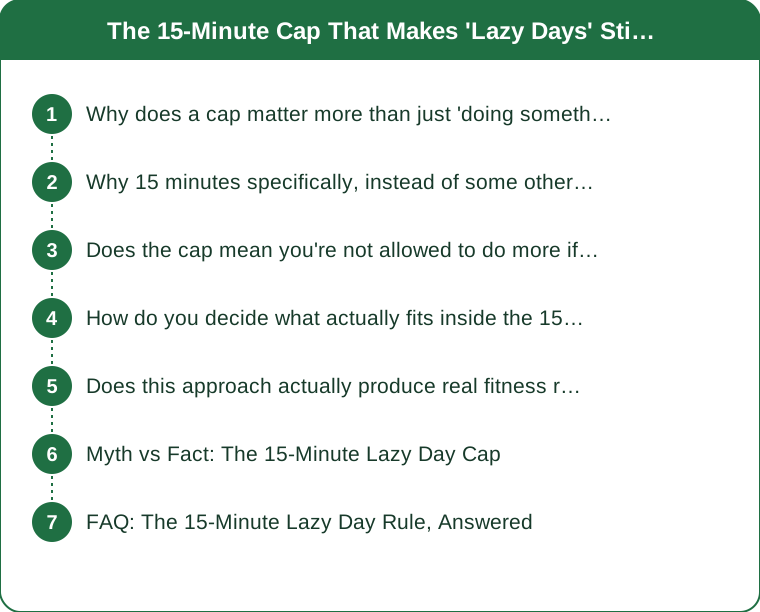
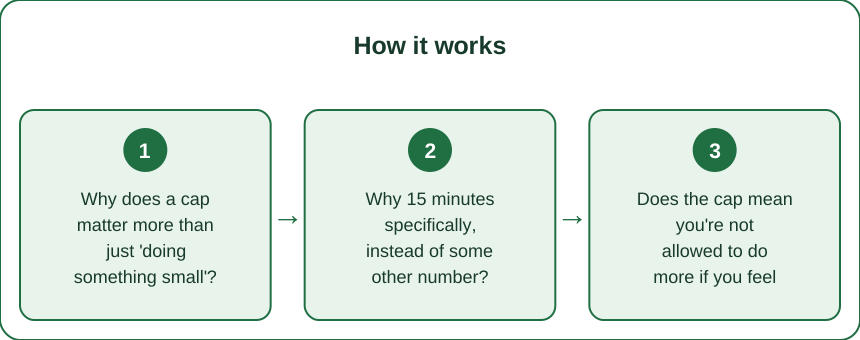
Why does a cap matter more than just ‘doing something small’?
Without a defined stopping point, a low-effort intention often drifts in one of two bad directions — it either grows into ‘well, I’m already moving, might as well do more’ and becomes exhausting, or it feels so open-ended and unstructured that it gets skipped entirely. A firm 15-minute cap removes both failure modes by making the low-effort version a specific, bounded commitment rather than a vague intention.
Why 15 minutes specifically, instead of some other number?
15 minutes is short enough to never feel like a real barrier on your lowest-energy days, but long enough to include a genuine short walk, a handful of bodyweight moves, or a real stretching sequence rather than something so brief it feels pointless. Some people use 10 or 20 minutes instead, and the exact number matters less than picking one and actually sticking to the cap consistently.
Does the cap mean you’re not allowed to do more if you feel like it?
You can always do more if energy shows up once you start — that’s a bonus, not a violation of the rule — but the cap protects the minimum commitment on days when more isn’t happening, regardless of motivation. The rule exists specifically for the days where 15 minutes is genuinely the ceiling of what’s realistic, not as a limit on good days.

How do you decide what actually fits inside the 15 minutes?
A simple menu works best: a short walk around the block, 5-10 minutes of stretching, a handful of bodyweight moves like squats and planks, or a slow yoga flow — the specific activity matters less than picking one in advance so a low-energy moment doesn’t also require a decision. Having 2-3 pre-decided low-effort options removes the extra friction of choosing something on a day when choosing anything already feels hard.
Does this approach actually produce real fitness results over time, or is it just a mental trick?
Both — the consistency benefit is real, since showing up in some form most days maintains habit strength far better than an all-or-nothing approach that leads to frequent full skips. The physical benefit of any single 15-minute session is modest, but the cumulative effect of never having a multi-day gap in the habit is what actually drives long-term results, more than the intensity of any individual session.
Myth vs Fact: The 15-Minute Lazy Day Cap
Myth — a 15-minute cap is just an excuse to not really try. Fact — the cap protects consistency by making the minimum version specific and achievable, which prevents the all-or-nothing skipping pattern that actually derails habits. Myth — if you’re capable of more, you should always push past the cap. Fact — the cap’s value comes specifically from being reliable and predictable, not from being maximized on good days.
FAQ: The 15-Minute Lazy Day Rule, Answered
How many lazy-cap days per week is reasonable before it becomes a pattern to address?
Using it 2-3 times a week alongside fuller workouts is sustainable for most people; using it most days may be worth examining for an underlying energy or motivation issue.
Does the 15-minute cap apply to nutrition and other habits too, or just movement?
The same capped, low-effort-but-bounded principle works well for other habits — a simple ‘good enough’ meal option counts the same way a 15-minute movement session does.
What if 15 minutes still feels like too much on a particularly hard day?
On genuinely rough days, even 2-3 minutes of light movement is enough to preserve the habit’s continuity; the cap is a ceiling for low-effort days, not a strict daily minimum that must be hit no matter what.
TL;DR:
- A hard cap prevents low-effort days from ballooning into overexertion or collapsing into skipping
- 15 minutes is short enough to never feel like a barrier but long enough to count as real movement
- Pre-deciding 2-3 low-effort options removes decision friction on hard days
- The consistency from never having a multi-day gap matters more than any single session’s intensity
The lazy-girl method isn’t really about permission to do less — it’s the firm stopping point that keeps a low-effort day from turning into no day at all.
Keep Reading
This article is for general informational and styling purposes only. Fit, sizing, and product availability may vary.