The 'Good Enough' Workout: When to Stop Optimizing and Just Move
Quick Answer: A workout counts as ‘good enough’ if it raises your heart rate or challenges a muscle group for at least 10-15 minutes, regardless of whether it matches an ideal program — consistency at ‘good enough’ beats sporadic perfection every time.
There’s a specific kind of procrastination that looks productive: researching the optimal split, the ideal rep range, the perfect warm-up — while the actual workout keeps getting pushed to tomorrow. The good-enough standard exists to short-circuit exactly that loop.

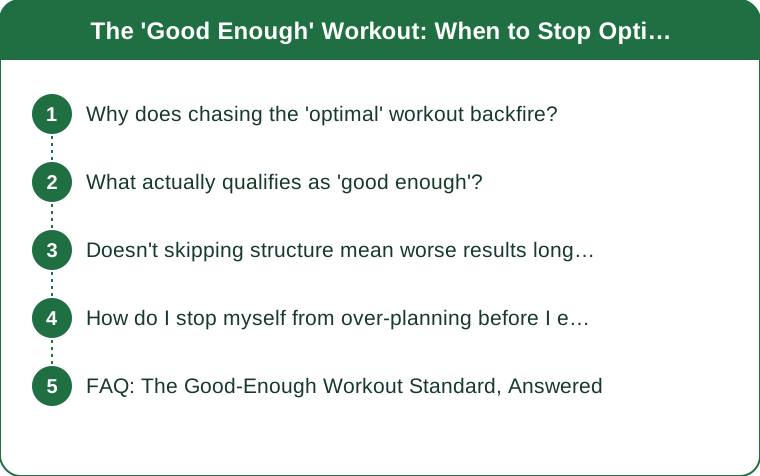
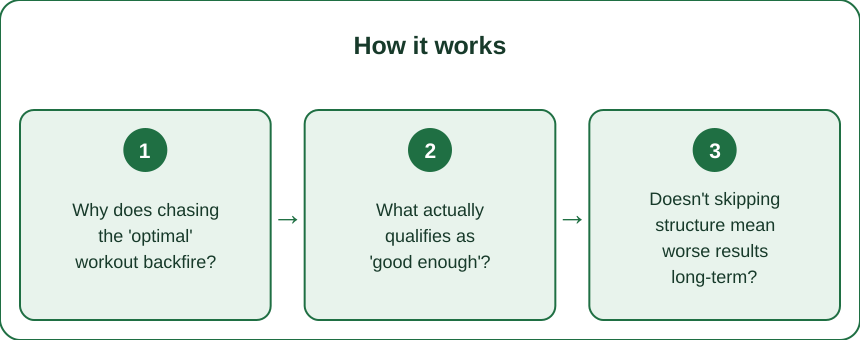
Why does chasing the ‘optimal’ workout backfire?
Decision fatigue and perfectionism together create a barrier to entry that’s often higher than the workout itself. Research on habit formation consistently shows that the biggest predictor of long-term exercise adherence is consistency, not program optimization — a mediocre plan done regularly outperforms a perfect plan done rarely.
What actually qualifies as ‘good enough’?
A useful bar: did it raise your heart rate or fatigue a muscle for 10-15 minutes. That’s it. A rushed bodyweight circuit, a fast walk with some stair intervals, an unstructured 12 minutes with dumbbells — all of it clears the bar, even without a plan behind it.

Doesn’t skipping structure mean worse results long-term?
For general health and consistency-building, the evidence doesn’t support that fear — most of the health benefits of exercise come from simply moving regularly at a reasonable effort, not from precise programming. Structure matters more once you’re chasing a specific performance goal, which is a different problem than ‘get moving today.‘
How do I stop myself from over-planning before I even start?
Set a planning time limit — 2 minutes to decide what today’s movement will be, then start. If a decision isn’t obvious in 2 minutes, default to a pre-picked fallback (a walk, a basic bodyweight circuit) rather than researching further.
FAQ: The Good-Enough Workout Standard, Answered
Isn’t this just an excuse to do less?
It’s the opposite in practice — the good-enough standard exists specifically to remove the excuse of ‘I don’t have the perfect plan,’ which is one of the most common reasons workouts get skipped entirely.
When should I actually start optimizing my program?
Once consistency itself is no longer the struggle — usually after several weeks of steady ‘good enough’ sessions — is a reasonable point to start refining structure toward a specific goal.
Does this apply to strength training too, or just cardio?
It applies to both. A quick, unstructured strength session that hits major muscle groups for 10-15 minutes still produces real adaptation over time, especially compared to the alternative of skipping the session while planning the ‘ideal’ one.
TL;DR:
- Chasing the optimal plan is often what prevents any workout from happening
- 10-15 minutes of raised heart rate or muscle fatigue clears the good-enough bar
- Consistency at ‘good enough’ beats sporadic perfection for almost every health outcome
- Cap planning time at 2 minutes, then default to a fallback if you’re still deciding
The workout that actually happens always beats the perfect one that stays in your head.
Keep Reading
This article is for general informational and styling purposes only. Fit, sizing, and product availability may vary.