The Lazy Girl Approach to Meal Planning That Actually Sticks (Because It's Barely Planning)
Quick Answer: A ‘lazy’ meal plan that sticks isn’t a smaller version of a detailed weekly plan — it’s a repeatable rotation of 4-5 meals you default to without deciding fresh each time, paired with a standing grocery list, removing the planning step almost entirely rather than doing it faster.
Every meal planning system promises to save time, and most require enough upfront effort that the planning itself becomes the thing you avoid. The actual lazy-sustainable version looks different from a smaller version of a detailed plan — it removes decisions, not just streamlines them.

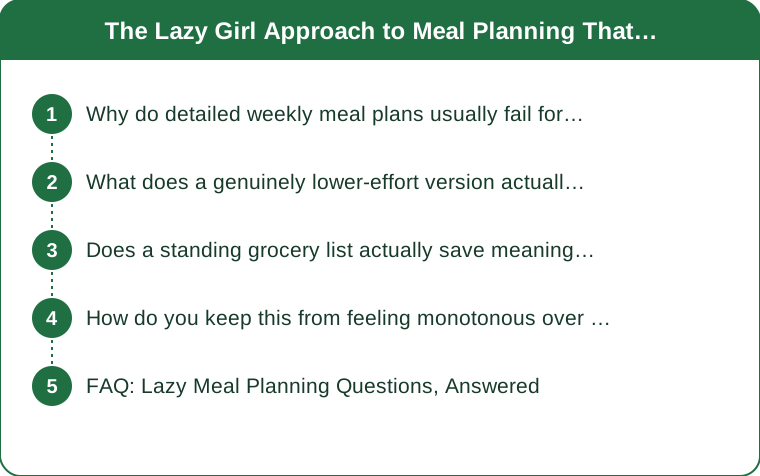
Why do detailed weekly meal plans usually fail for people who dislike planning?
A full weekly plan still requires making 7-14+ individual food decisions in one sitting, which is exactly the kind of decision-heavy task that feels effortful regardless of how organized the resulting spreadsheet looks. The plan itself becomes a chore, which defeats its purpose for someone trying to reduce mental effort around food.
What does a genuinely lower-effort version actually look like?
A fixed rotation of 4-5 meals you make on repeat, rather than a new plan each week. This removes the decision entirely — you’re not choosing what to eat, you’re pulling from a known, already-approved short list. Boredom risk is lower than it sounds, since most people eat a fairly repetitive rotation naturally anyway, just without acknowledging it as a system.

Does a standing grocery list actually save meaningful time?
Yes — pairing the fixed rotation with a standing grocery list (the same core items, restocked weekly with minor additions) removes the separate decision-making step of building a new list from scratch, which is often the more tedious part of meal planning than the cooking itself.
How do you keep this from feeling monotonous over time?
Rotating in one new meal every few weeks, replacing the least-liked option in the current rotation rather than overhauling the whole system, keeps some variety without reintroducing the decision fatigue a fully fresh weekly plan creates. Small, occasional changes preserve the low-effort core of the system.
FAQ: Lazy Meal Planning Questions, Answered
How many meals should actually be in the rotation to avoid boredom?
4-5 dinner options is a reasonable range for most people — enough variety to avoid feeling repetitive, few enough to stay genuinely low-effort to plan around.
Does this work for people cooking for a family, not just themselves?
Yes, with adjustment — a slightly larger rotation (6-8 meals) and involving family members in occasional rotation swaps keeps it low-effort while accounting for more preferences.
Is meal prepping in bulk still worth doing with this system?
Often yes — a fixed rotation makes bulk prep more efficient than a varying weekly plan would, since you’re buying and prepping the same core ingredients repeatedly rather than something different each week.
TL;DR:
- Detailed weekly meal plans fail because they still require many individual decisions upfront
- A fixed 4-5 meal rotation removes the decision entirely rather than just streamlining it
- A standing grocery list eliminates a separate, often more tedious planning step
- Swapping in one new meal every few weeks keeps variety without reintroducing decision fatigue
Keep Reading
This article is for general informational and styling purposes only. Fit, sizing, and product availability may vary.