The Shelf Rule: Put the Thing Where the Decision Actually Happens
Quick Answer: Habits fail at the moment of decision, not at the moment of intention. If the thing you need is not physically present where that decision happens, the decision defaults to no. Move the object rather than increasing the motivation - vitamins beside the kettle, resistance band on the sofa arm, trainers by the door you actually use. It is the lowest-effort behaviour change available.
You did not forget. You knew perfectly well the vitamins were in the cupboard.
And at 7:40am, with the kettle on, the cupboard was two metres too far away.

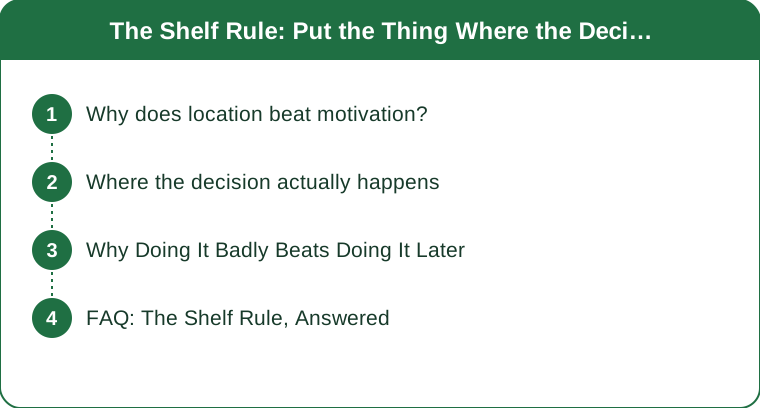
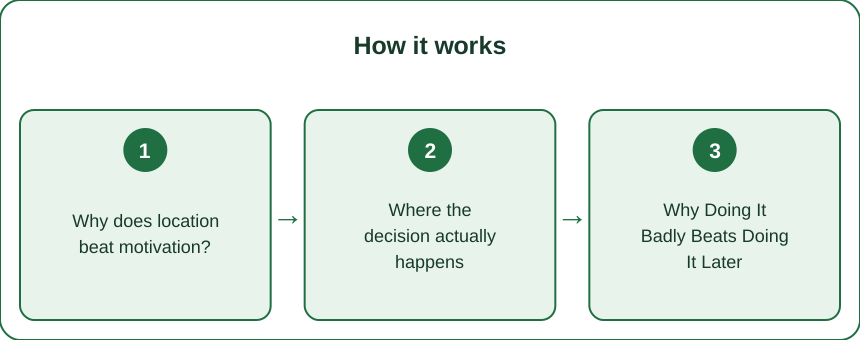
Why does location beat motivation?
Decisions get made in a specific place at a specific moment, and that moment is usually short and busy. Whatever is visible and reachable at that moment has an enormous advantage over whatever is not.
Motivation is highest when you are planning and lowest when you are acting, which is the whole problem. You buy the vitamins in a burst of intent and take them in a state of hurry.
Every step of friction removes a chunk of follow-through. Opening a cupboard, moving something aside, and finding a glass are three steps, and any one of them is enough to lose a rushed morning.
Visibility does independent work. Objects in sight act as cues, and a cue at the right moment is worth more than a reminder at the wrong one - which is why phone alerts so often fail while a bottle on a counter succeeds.
This is why the fix is physical rather than mental. You are not trying to want it more; you are trying to make the no take more effort than the yes.
And it is genuinely low effort, which matters. Moving one object takes ten seconds and does not need to be sustained.
Where the decision actually happens
Find the exact spot, not the general room. The vitamins decision happens at the kettle, not in the kitchen. The stretching decision happens on the sofa, not in the living room. Precision is the whole method.
Water: a full bottle beside where you sit and work, not in the fridge. The fridge is a decision to get up, which is a different and much harder decision.
Stretching or mobility: a mat or band on the sofa arm where you watch television, because that is where the free ten minutes actually exists.
Walking: shoes by the door you use, which for many people is not the front door. Shoes at the wrong door are decoration.
Gym: the bag packed and in the car, because the decision happens when you are leaving work, not when you are at home with time to prepare.
Protein or a decent snack: at eye level in the fridge, in front of everything else. Eye level is a real effect and it costs nothing to use.

Why Doing It Badly Beats Doing It Later
Two vitamins taken standing at the kettle beat a perfect supplement routine you do twice a month. Consistency compounds and perfection does not, and the version you actually do is the only version that exists.
Three minutes of stretching on the sofa in your clothes is worth more than a 20-minute floor routine you keep postponing to a better evening.
A ten-minute walk in the wrong shoes beats the 45-minute one you were saving for the weekend and then did not do.
The reason is not motivational, it is mathematical. A small thing done 300 times a year outperforms a large thing done twelve times, and it does so by a wide margin in almost every health behaviour that has been measured.
Doing it badly also keeps the identity intact, which turns out to matter. People who do a reduced version on bad days return to the full version faster than people who skip entirely.
And badly is usually temporary. Once the object is in the right place and the habit exists, the quality tends to improve on its own without any extra effort - which is the opposite of how people expect habits to work.
FAQ: The Shelf Rule, Answered
Why do I forget things I genuinely want to do?
Because the decision happens in a short, busy moment and the thing was not present in it. That is a location problem rather than a memory or motivation problem.
Does this work for things I actively avoid?
Partly. Location removes friction but does not remove dislike. For things you avoid, pair the location change with a smaller version - three minutes rather than twenty.
Will my house end up covered in stuff?
Only if you do all of them at once. Pick one or two, and once the habit runs on its own, most people find the object can go back to a normal place.
Do phone reminders work as well?
Rarely. A reminder arrives at a scheduled time; a visible object arrives at the actual moment of decision, which is why the object usually wins.
What if the right spot is somewhere untidy or awkward?
Then tidiness and the habit are competing, and you get to decide which matters more for the next month. Often a small dedicated container solves both.
How long until I do not need the prompt?
Usually a few weeks for simple things, longer for anything effortful. There is no need to remove it though - a permanent cue costs nothing.
What is the single best place to start?
Water beside where you sit and work. It is the easiest to set up, the effect is immediate, and it demonstrates the principle well enough to apply everywhere else.
TL;DR:
- Habits fail at the moment of decision, and that moment is short, busy, and located somewhere specific.
- Move the object to that exact spot rather than trying to want it more - vitamins at the kettle, band on the sofa arm, bag in the car.
- Find the precise place, not the general room. Shoes at the wrong door are decoration.
- Every step of friction removes follow-through, and visibility acts as a cue at the right moment in a way a phone alert does not.
- A small thing done 300 times a year beats a large thing done twelve times.
Start with water beside where you work. It takes ten seconds to set up and shows you how the whole principle behaves.
Keep Reading
This article is for general informational and styling purposes only. Fit, sizing, and product availability may vary.