The Two-Minute Rule (Lowering the Bar Until It Is Impossible to Skip)
The reason most healthy habits fail is not laziness — it is that they were set at a size requiring motivation, and motivation is not available on the days that matter. Shrinking the commitment until refusing it feels absurd solves more than any amount of discipline. Here is why tiny commitments work, how to apply the rule, and how to scale it.

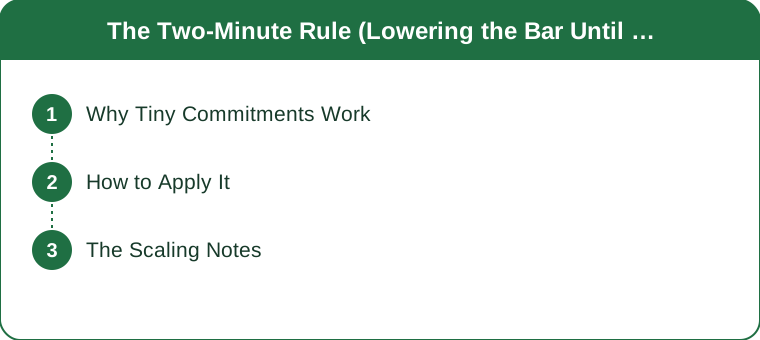
Why Tiny Commitments Work
Removing the decision: the the-the-decision-is-the-hard-part (the deciding rather than doing being the obstacle from the low-effort-habits logic — the decision-is-the-hard-part), the the-two-minutes-removes-the-argument (the a two-minute version leaving nothing to negotiate from the low-effort-habits logic — the removes-the-argument), the the-starting-is-most-of-it (the beginning usually leading to continuing from the workout-guide logic — the starting-is-most-of-it), the the-it-does-not-depend-on-motivation (the tiny commitments surviving low-motivation days from the low-effort-habits logic — the motivation-independent), the the-consistency-compounds-more-than-intensity (the frequency mattering more than session size from the low-effort-habits logic — the consistency-compounds), and the reframe (the failed habit as usually set too large — with a two-minute version removing the argument entirely, because the decision was always the hard part).

How to Apply It
Shrinking the commitment: the the-name-the-two-minute-version (the defining explicitly what two minutes looks like from the low-effort-habits logic — the name-the-tiny-version), the the-commit-only-to-starting (the committing to beginning rather than finishing from the workout-guide logic — the commit-to-starting), the the-two-minutes-of-movement (the a two-minute walk or stretch counting fully from the workout-guide logic — the two-minutes-movement), the the-one-page-of-reading (the a single page satisfying a reading habit from the self-care logic — the one-page), the the-one-tidy-surface (the clearing one surface rather than a room from the evening-routine logic — the one-surface), the the-put-the-clothes-on (the just changing into training clothes as the commitment from the workout-guide logic — the just-change-clothes), the the-anchor-it-to-an-existing-habit (the attaching it to something you already do from the morning-routine logic — the anchor-it), and the the-you-are-allowed-to-stop-at-two-minutes (the genuinely being allowed to stop being what makes it work from the low-effort-habits logic — the allowed-to-stop).
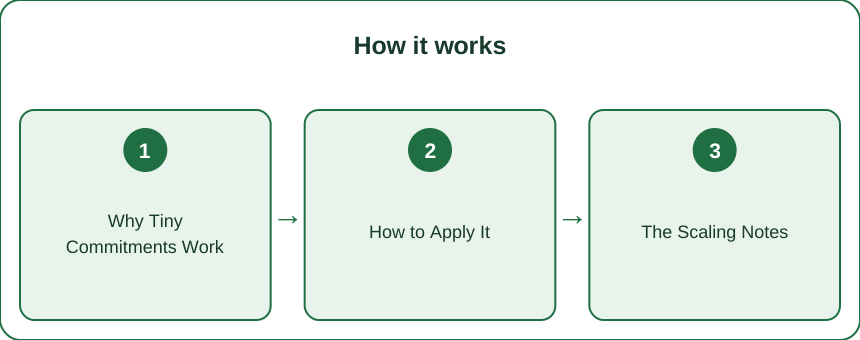
The Scaling Notes
Letting it grow: the the-do-not-raise-the-bar-too-early (the keeping the commitment tiny even when doing more from the low-effort-habits logic — the do-not-raise-too-early), the the-the-tiny-version-stays-the-commitment (the the official commitment remaining two minutes permanently from the low-effort-habits logic — the tiny-stays-the-commitment), the the-more-happens-naturally-most-days (the most sessions exceeding two minutes without being required to from the workout-guide logic — the more-happens-naturally), the the-on-bad-days-two-minutes-is-the-win (the the tiny version protecting the streak on hard days from the low-effort-habits logic — the bad-days-two-minutes), the the-never-miss-twice (the resuming immediately after any miss from the low-effort-habits logic — the never-miss-twice), the the-add-a-second-habit-only-when-the-first-is-automatic (the introducing new habits one at a time from the self-care logic — the one-at-a-time), the the-the-streak-matters-more-than-the-session (the continuity outweighing any individual session from the low-effort-habits logic — the streak-over-session), and the frame (the two-minute rule as removing the decision — the commitment named tiny, anchored to an existing habit, permitted to stop, and never raised even when you routinely do more. Name the two-minute version, commit only to starting, anchor it to an existing habit, and never raise the official commitment).
The reason most healthy habits fail is not laziness — it is that they were set at a size requiring motivation, and motivation is not available on the days that matter. Tiny commitments work because the decision is the hard part, two minutes removes the argument, starting is most of it, it does not depend on motivation, and consistency compounds more than intensity. Apply it by naming the two-minute version, committing only to starting, doing two minutes of movement, one page of reading, one tidy surface, or just putting the clothes on — anchored to an existing habit, and genuinely allowed to stop. Scale it by not raising the bar too early, keeping the tiny version as the official commitment, letting more happen naturally, treating two minutes as the win on bad days, and never missing twice.
Keep Reading
This article is for general informational and styling purposes only. Fit, sizing, and product availability may vary.