Why Putting the Clothes On Is the Whole Habit
Quick Answer: Putting on workout clothes works as a habit because it separates the decision from the effort. You are not committing to a session, only to changing clothes, which is a low enough bar that resistance does not have time to build. Once dressed, the cost of not exercising rises - you have to change back, and the visual cue keeps prompting you - so the workout tends to happen without ever being decided on. Treat the clothes as the habit and the workout as the by-product.
You have skipped four days in a row. Not because the workout is hard, but because you never got past the part where you think about doing it.

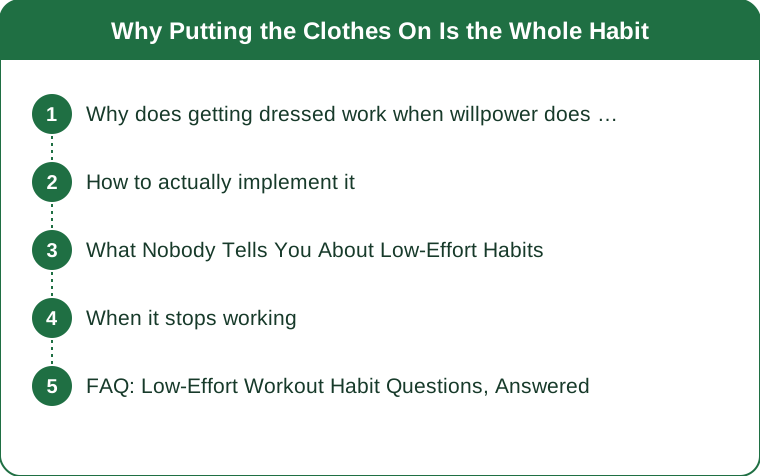
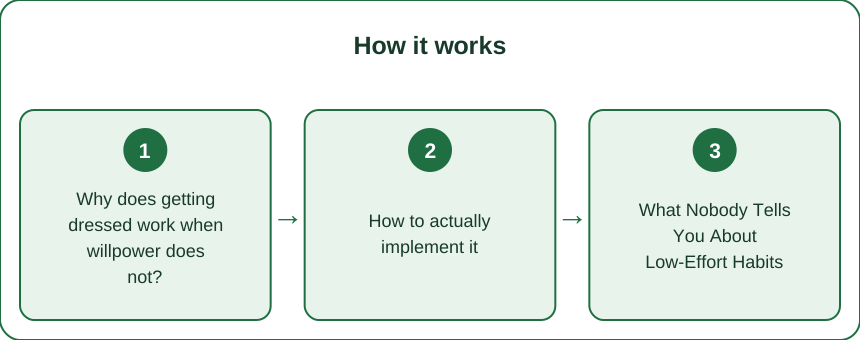
Why does getting dressed work when willpower does not?
Because it changes what you are deciding about.
The resistance sits at the decision, not the exercise. Almost nobody dreads minute fifteen of a workout. They dread the moment of committing to it, which happens while sitting down with something else available.
A two-minute action does not trigger resistance. Changing clothes takes about ninety seconds and requires no willpower to consider. It slides under the threshold where your brain starts negotiating.
Being dressed changes the default. Before, doing nothing was free. After, doing nothing has a cost - you have to change back, which is mildly absurd, and something in you notices that.
It creates a persistent visual cue. You keep catching sight of yourself in workout clothes, and each glance is a small prompt. Cues that persist outperform cues that fire once.
There is also a small identity effect. Dressed for exercise, you are momentarily a person who exercises, and behaviour tends to follow the identity you are currently occupying rather than the one you intend to occupy.
And crucially, it is honest. You genuinely are allowed to change back. The habit only works if that permission is real, because a trick you know is a trick stops working within a week.
How to actually implement it
Simple, but there are a few details that decide whether it sticks.
Attach it to something you already do. After the morning coffee, after dropping the kids off, after closing the laptop at 5pm. An unattached intention lands nowhere; an attached one has a specific trigger.
Lay the clothes out the night before. This removes the second decision - which leggings, is that top clean - which is where the ninety-second action quietly becomes a ten-minute one.
Set the bar at changing clothes and nothing else. Not changing plus starting. The moment you attach a second requirement, resistance returns and the whole mechanism breaks.
Give yourself the genuine option to stop there. Some days the answer really is no, and honouring that is what keeps the habit credible. Expect it to convert to a workout perhaps three or four times out of five, which is a dramatically better rate than deciding cold.
Include shoes. This is the detail people skip and it matters more than it should. Shoes on is a substantially stronger signal than leggings on, and it is the point where most people stop reconsidering.
Keep a five-minute version available. If you are dressed and unwilling, the alternative should not be nothing - it should be five minutes of something. Ten squats and a walk around the block still counts, and it keeps the chain intact.
And track the clothes, not the workouts. Mark the day if you got dressed. It rewards the behaviour you are actually building.

What Nobody Tells You About Low-Effort Habits
The point of a low bar is not lower results, it is fewer decisions. People assume the minimum-effort approach produces minimum outcomes. In practice it produces consistency, and consistency at a low level beats intensity at an irregular one over any timescale longer than a month.
The clothes trick stops working if you cheat it. If you start telling yourself you must work out once dressed, your brain re-labels changing clothes as committing to a workout, and the resistance moves back to the beginning. The permission has to be genuine.
It works best on the days you least want to. On a good day you would probably have trained anyway. The value is entirely concentrated in the mediocre days, which is also where the annual total is decided.
Getting dressed at the wrong time is a common failure. Changing at 9pm when you are not going to train just teaches your brain that being dressed means nothing. Attach it to a time when training is actually plausible.
The comfortable clothes get worn; the good ones do not. Whatever you are slightly precious about will not be the outfit you throw on at 6am. Keep the easy set at the front of the drawer.
It generalises to other things. Opening the document. Filling the water bottle. Putting the running shoes by the door. The mechanism is the same in each case - shrink the action until deciding is unnecessary.
And it stops being needed eventually, mostly. After a couple of months the sequence runs on its own, though it usually comes back in useful after a holiday or an illness resets the pattern.
When it stops working
It will stall at some point. The reasons are fairly predictable.
You added requirements without noticing. Check whether getting dressed has quietly come to mean a full 45 minute session. Shrink it back.
The trigger disappeared. Habits attached to a routine break when the routine changes - a new job, school holidays, a different commute. Reattach it to something in the new pattern rather than trying to push harder.
The clothes are not accessible. If the leggings are in the wash and the drawer is a mess, the ninety seconds became five minutes and the mechanism is gone. This is the most common and most fixable failure.
You are genuinely under-recovered. Sometimes the resistance is information rather than laziness. Persistent, whole-body reluctance alongside poor sleep and lingering soreness is a recovery signal, and pushing through it with clever tricks is not the answer.
Boredom rather than resistance. If you get dressed and still do not want to train, but you feel fine, the problem is the workout rather than the habit. Change what you are doing.
Restart small after any break. Coming back from a week off, drop to the clothes-only version for a few days and let the sequence rebuild before adding expectations.
And do not diagnose a two-day gap as a failed habit. Two days is a weekend. Four weeks is a pattern.
FAQ: Low-Effort Workout Habit Questions, Answered
Does putting on workout clothes actually make you exercise?
For most people it converts three or four times out of five, which is far better than deciding cold. It works because you commit to changing clothes rather than to a workout, which is a low enough bar to bypass the resistance.
What if I get dressed and still do not work out?
That is allowed and it is essential to the mechanism. If the permission is not genuine, your brain re-labels getting dressed as committing to a session and the resistance returns.
When should I put the clothes on?
Attached to something you already do at a time when training is plausible - after the morning coffee, after finishing work. An unattached intention has no trigger and quietly disappears.
Do the shoes really matter?
More than you would expect. Shoes on is a much stronger signal than leggings on, and it is the point at which most people stop reconsidering.
Is a five-minute workout worth doing?
Yes, particularly for keeping the pattern alive. Five minutes maintains the habit chain on days when a full session is not happening, and the chain is what produces the annual total.
TL;DR:
- Commit to changing clothes, not to a workout - the resistance lives at the decision, not the exercise.
- Attach it to an existing routine and lay the clothes out the night before.
- Keep the permission to stop there genuine, or the mechanism breaks within a week.
- Include shoes; it is a far stronger signal than the rest of the outfit.
- Track the days you got dressed, not the days you trained.
You are not building a workout habit. You are building a getting-dressed habit, and the workouts show up on their own about four days out of five.
See It in Motion
Seen here: High Waist 8” Yoga Shorts — shop similar styles on bubblelime.com
Keep Reading
This article is for general informational and styling purposes only. Fit, sizing, and product availability may vary.