Why the Two Minute Rule Beats an Actual Workout Plan
Quick Answer: The two-minute rule works because it targets the decision point rather than the workout. A plan asks you to choose whether to do 45 minutes; a two-minute commitment asks almost nothing, so the resistance disappears. Once you are moving, continuing is far easier than starting — which is why most two-minute sessions become fifteen. The rule builds the identity and the cue; the volume follows on its own.
You have written a plan. Four days a week, progressive, sensible.
You did it for eleven days.
The plan was not the problem. The eleven decisions were.

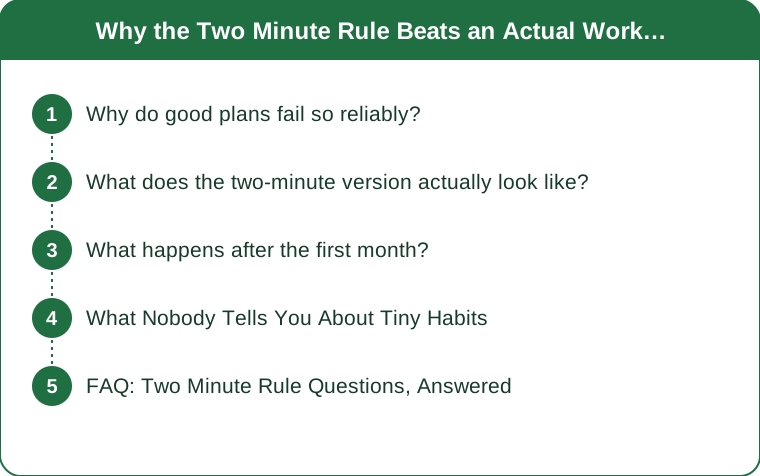
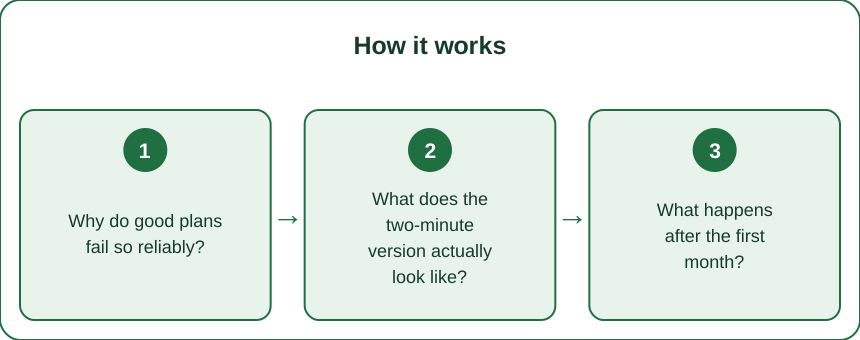
Why do good plans fail so reliably?
Because they load all their difficulty into the moment you have the least capacity to handle it.
Every session requires a fresh decision. A plan does not remove choice, it schedules it. On a tired Tuesday you are still deciding, and the decision costs energy you do not have.
Ambitious plans raise the cost of starting. Knowing a session is 45 minutes makes the threshold high. High thresholds get skipped on exactly the days when consistency matters most.
Missing one day breaks the structure. Plans have an implied all-or-nothing quality. Miss Wednesday and the week is spoiled, and a spoiled week is easy to abandon entirely.
Motivation is treated as an input rather than an output. Plans assume you will want to. Motivation actually tends to follow action rather than precede it.
They optimise for the wrong variable. A perfect plan you do 30 percent of the time is worse than an imperfect one you do 90 percent of the time, and plans are almost always designed for the ideal week.
They ignore the cost of setup. Changing clothes, finding the mat, getting to the gym. For a 45-minute session that overhead is proportionate. For a habit you are still building, it dominates.
What does the two-minute version actually look like?
Absurdly small, deliberately. That is the mechanism, not a compromise.
The commitment is two minutes, and it is genuine. You are allowed to stop at two minutes. If you do not mean this, the rule does not work, because your brain knows when it is being tricked.
Pick something with almost no setup. Bodyweight squats in the kitchen. Two minutes of stretching by the bed. A walk to the end of the street. Anything requiring a change of clothes and a drive is not a two-minute habit.
Attach it to something you already do. After the kettle goes on. After you close the laptop. Existing routines are the cheapest cues available and they need no willpower to remember.
Same time, same place, every day. Repetition of context is what converts a behaviour into an automatic response. Variety is the enemy here.
Do it every day, not four days a week. Daily is easier than four times a week, because there is no decision about whether today counts.
Log it. A tick on a calendar. The visible chain is not childish; it is a genuinely effective reinforcement mechanism.
Do not increase it deliberately for a month. The temptation to scale up as soon as it feels easy is what breaks it. The habit is the goal for the first month; the fitness comes after.

What happens after the first month?
The behaviour stops requiring a decision, and then the volume grows without effort.
Most sessions stop being two minutes. Starting is the barrier. Once you are already squatting, continuing to ten minutes is nearly free, and this happens naturally in the majority of sessions.
Your identity shifts before your fitness does. Becoming someone who moves every day changes the default answer to a hundred unrelated decisions, and this effect is larger than the two minutes themselves.
Bad days become two-minute days rather than zero days. This is the whole value. The chain survives illness, travel and heavy work weeks, and the chain surviving is what produces results over a year.
Now you can add structure. Once the daily habit is automatic, layering a real programme on top works, because the hard part is already handled.
Expect the honeymoon to end around week three. The novelty fades and the behaviour is not yet automatic. This is the point where people quit, and knowing it is coming helps enormously.
Do not stack multiple new habits at once. One at a time. Two simultaneous new habits roughly halve the success rate of each.
Seasonal note: dark mornings arriving through autumn is the single most common reason daily habits collapse. Move the two minutes to a time that is not weather-dependent before the clocks change, not after.
What Nobody Tells You About Tiny Habits
Two minutes feels insulting, and that is why it works. The resistance you feel is proportional to the perceived size of the task. Making it trivially small removes the resistance entirely.
You will want to skip logging on the days you only did two minutes. Do not. Those are the most important ticks on the calendar because they are the ones that keep the chain alive.
Nobody who does this for a year is still doing two minutes. The rule is scaffolding. It gets removed once the building stands.
The days you least want to do it are worth the most. A two-minute session on a terrible day reinforces the habit far more than a good session on an easy day.
Missing one day is fine. Missing two is the risk. The research-backed version of this is simply never missing twice in a row, and it is far more forgiving than a perfect streak.
Your first two-minute habit should not be the one you care about most. Practise the mechanism on something low-stakes. Once you trust it, apply it to what matters.
The plan is not wasted. Write it. Keep it. Start using it in month two, when there is a habit to attach it to.
FAQ: Two Minute Rule Questions, Answered
Does two minutes of exercise do anything physically?
On its own, very little. That is not what it is for. It is a habit mechanism whose output is the sessions it eventually becomes.
What if I genuinely stop at two minutes every time?
Then you have a daily movement habit, which is more than most people manage. Keep going for a month before judging it.
How long until it feels automatic?
Commonly quoted figures range widely, but around two months is a reasonable expectation for a simple daily behaviour in a consistent context.
Should I do it in the morning?
Whenever is most reliably repeatable. Morning is popular because fewer things interfere, not because it is physiologically superior.
What if I miss a day?
Start again the next day. Never miss twice consecutively — that is the only rule that matters.
Can I use this for things other than exercise?
Yes, and it works on most of them. Just not several at once.
TL;DR:
- Plans fail at the decision point, not the workout. Two minutes removes the decision.
- Make it genuinely tiny, attach it to an existing routine, same time and place daily.
- Log every day, especially the two-minute ones.
- Most sessions grow on their own. Do not force the increase for a month.
- Never miss twice in a row. That is the whole discipline.
Pick something you can do in the next ten minutes without changing clothes. That is your habit.
Keep Reading
This article is for general informational and styling purposes only. Fit, sizing, and product availability may vary.